VETROVERSE
An Immersive Memory-finding Puzzle VR Game Bridging Reality and Virtuality
Keywords:
Virtual Reality, Game Design, Immersion, Interactive Storytelling, Gesture Interactions
Role:
Ideation, Game Mechanic Design, Unity Scene Design, Prototyping
Team:
May Choy, Qiyao Chen, Yuhan Wang
Date:
2024


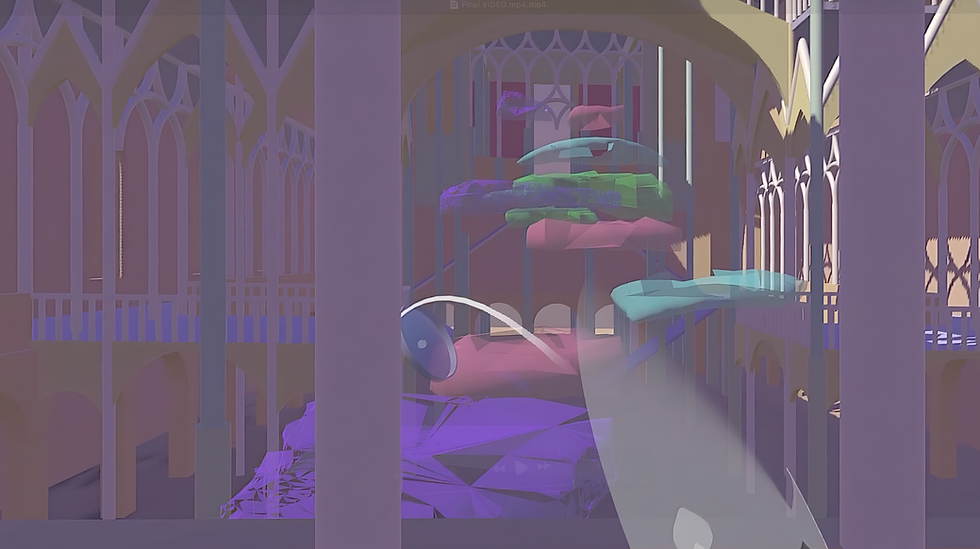
Vetroverse is a virtual reality-based puzzle game that explores memories through immersive gameplay interactions. The term "Vetro" is rooted in the Italian word for glass. The player’s objective is to find hidden glass shards within a memory palace. With each shard discovered, a memory fragment is revealed, gradually uncovering the protagonist’s story.
The immersive puzzle game features two main mechanisms. The first is to use VR controllers to move objects and pick them up in a room. The second is lens distortion: the player finds a camera lens as a magical prop, which can be used as a magnifier to reveal hidden objects and flashback forgotten memories. Using VR controllers and hand gestures to make a more interactive storytelling experience.
The player plays as the last glass artisan in the world, a glass collector who suffers from a loss of connection between thoughts and memories. The player’s goal is to recover the hidden memories by collecting the scattered glass shards. This game is inspired by Murano Island in Venice. The narrative of the hidden memories of the protagonist was inspired by the history Industrial Revolution and World War II, where the entire glass island is forced to be demolished for something more utilitarian, such as transforming a beautiful glass studio into a factory. The glass studio is destroyed, and the protagonist loses her studio and family, which triggers her memory loss, and an imagined herself as a happy collector. The game aims to draw attention to the traditional glassblowing techniques that have been forgotten due to mass-produced industrialization, with handcrafted artifacts filled with emotion replaced by industrialized, mass-produced merchandise. The narrative is revealed through small but impactful interactions with objects, encouraging players to engage deeply with the protagonist’s memories. This storytelling approach—using fragments and hidden items—keeps players engaged in uncovering the protagonist’s past.
Story Board

User FLow

System Design
Interactivity and Feedback Loops Mechanics System

System of Objects, Attributes, Relationships, Environment, and Cognitive and Cultural layers

Paper Prototype
Lens Mechanics and Panorama Viewer Test


User Interface Design


Prototype
Chapter 1: Open World


Shatter Collection


Shatter Collection
Memory Fleshback


Chapter 2: Glass Palace


Get Memory Glass Shatter and Fleshback


Scene of Reality in Hospital
Panorama Render
Scene of Home Explosion Memory


